Hills Co Sheriff refers to two distinct law enforcement agencies serving different regions: the Hillsborough County Sheriff’s Office in Florida and the Hill County Sheriff’s Office in Texas. Both agencies maintain strong digital presences, offer real-time public records access, and actively engage with their communities. The Hillsborough County Sheriff’s Office, led by Sheriff Chad Chronister, serves over 1.5 million residents across Tampa and surrounding areas. Meanwhile, the Hill County Sheriff’s Office in Texas, under Sheriff Rodney B. Watson, protects a rural population of about 36,000 across 1,218 square miles. Both offices provide transparent, up-to-date tools for arrest inquiries, warrant searches, and community outreach. This page delivers accurate, timely information directly from official sources, ensuring residents can stay informed, report concerns, and verify legal records safely and efficiently.
Hillsborough County Sheriff’s Office: Leadership, Operations, and Public Safety
The Hillsborough County Sheriff’s Office (HCSO) operates as one of Florida’s largest law enforcement agencies. Sheriff Chad Chronister leads daily operations from the main headquarters in Tampa. HCSO manages county jails, responds to emergencies, investigates crimes, and supports community programs. The office opened a criminal investigation on March 12, 2024, after detecting a $12,730 payroll discrepancy in the Records Division. Detectives traced the shortfall over six months to Michael T. Reynolds, a 42-year-old administrative assistant. On March 15, 2024, a coordinated raid with Tampa Police Department resulted in his arrest at 3102 North River Drive. In a separate case from August 3, 2022, HCSO released surveillance footage of a male suspect, described as 5 ft 11 in and 190 lbs, wearing a dark leather jacket, who stole an undisclosed amount from a downtown bank. Investigators continue reviewing witness statements and footage to identify the robber.

HCSO emphasizes transparency and public access. Its real-time Arrest Inquiry system refreshes every 30 minutes, displaying booking photos, names, charges, bond amounts, and court dates. Records remain available for 90 days post-release unless sealed by court order. Users can search by name, booking number, or case type. Results include downloadable PDFs compatible with desktop and mobile browsers. The Warrant Inquiry portal updates daily at 2:00 a.m., listing active bench, bench-sale, and bench-arrest warrants. Each entry shows issuing court, bond amount, and filing date. A clear disclaimer reminds users that data is informational only and not legal advice.
Hill County Sheriff’s Office: Rural Service, History, and Community Engagement
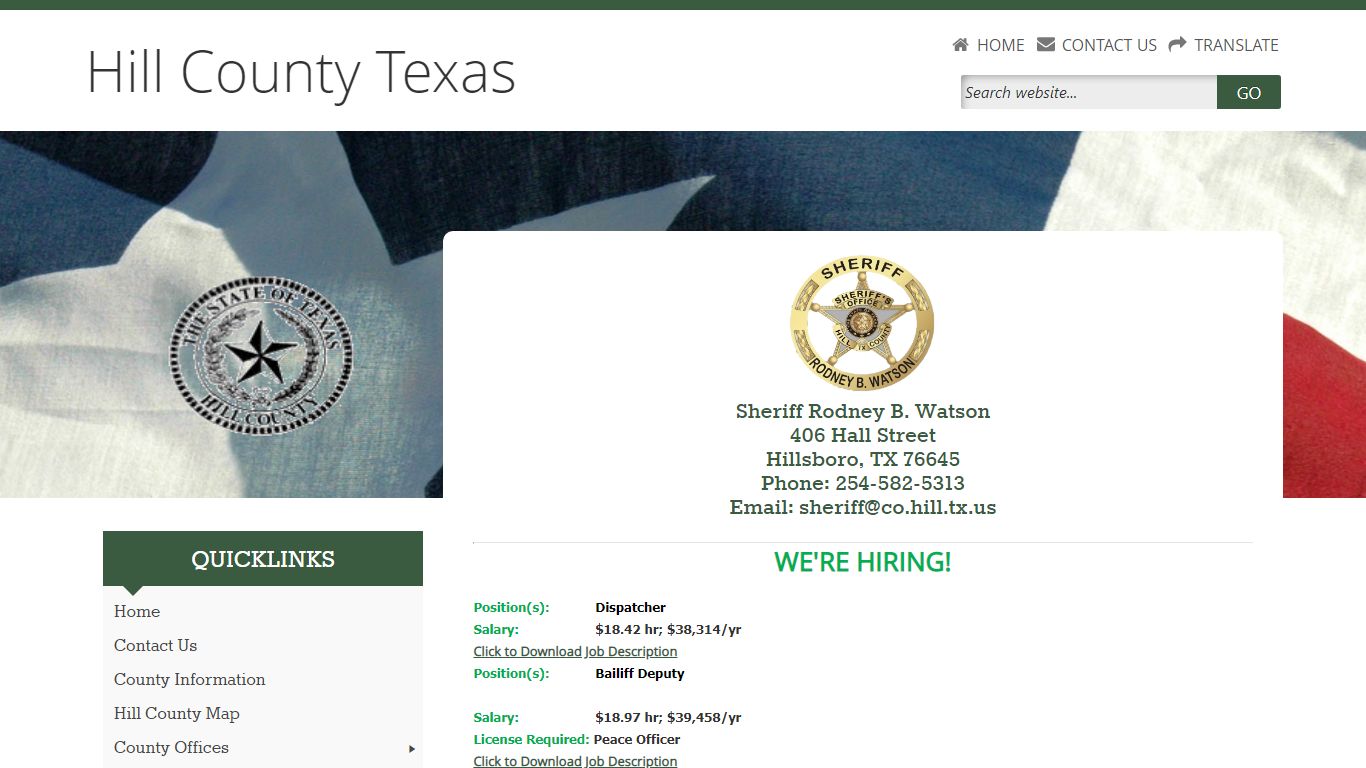
The Hill County Sheriff’s Office in Texas serves a rural population of approximately 36,000 across 1,218 square miles. Sheriff Rodney B. Watson leads the department from its headquarters at 406 Hall Street, Hillsboro, TX 76645. The office operates a 24-hour dispatch center, forensic unit, and community-policing team. Monthly safety workshops are held in local schools to educate youth on crime prevention and emergency response. Residents can reach non-emergency services at 254-582-5313 or via the official public email. Prospective deputies use an online portal to submit background checks, physical fitness results, and written statements for review.
The Hill County Sheriff’s Office has a rich history dating back to the early 20th century. Sheriff Henry E. Loranger served from 1911 to 1915, overseeing the shift from horse-drawn patrols to motorized units. Sheriff George L. Bickle (1916–1917) introduced formal record-keeping. Sheriff Mathew McLain (1917–1919) coordinated medical transport during the 1918 influenza pandemic. Sheriff Henry F. Schwartz (1920–1922) expanded jurisdiction to unincorporated areas. Sheriff Roscoe C. “Doc” Timmons served a record 44 years (1923–1967), modernizing forensics and establishing the county cemetery registry. Later sheriffs Haston Broadus (1968–1971) and Howard Taylor (1972–1986) adopted radio communications and created the coroner’s investigative unit.
Real-Time Arrest and Warrant Inquiry Systems
Both sheriff offices offer advanced digital tools for public record access. The HCSO Arrest Inquiry system updates every 30 minutes, ensuring near real-time accuracy. When someone is booked, their photo, full name, date of birth, charges, bond amount, and court date appear within minutes. The system supports searches by name, booking number, or case type. Users receive a downloadable PDF of the booking sheet. The platform works on all devices, including smartphones and tablets. Records stay online for 90 days after release unless sealed by court order. This system helps families, attorneys, and researchers verify detention status quickly.
The HCSO Warrant Inquiry portal allows residents to search for active warrants using a full name, date of birth, or warrant ID number. Results show warrant type, issuing court, bond amount, and filing date. The database refreshes daily at 2:00 a.m. to include new court filings. A prominent disclaimer states that information is for reference only and should not be used for legal decisions without consulting an attorney. This protects both the public and the agency from misuse of sensitive data.
Geographic Information Systems and Jurisdictional Mapping
The Hillsborough County Sheriff’s Office provides an interactive GIS portal for city and district boundaries. Users can toggle layers for municipal limits, law enforcement districts, precincts, and electoral zones. The map includes zoom tools, distance measurement, and print options at a scale of 1:300,000. Basemap choices include satellite imagery, topographic contours, and street maps. All boundary data come from the county planning department and are updated annually to reflect annexations or jurisdictional changes. This tool helps residents understand patrol zones, voting districts, and service areas.
Community Services, Reporting Tools, and Public Engagement
HCSO offers multiple online services beyond arrest and warrant searches. The Arrest Inquiry portal includes a “State of Florida 511 Tampa Bay Travel Information” feed for real-time traffic alerts. Residents can report abandoned vehicles, junk accumulation on private property, or missing address signs. Each submission generates a case number for online tracking. The system logs date, location, and nature of the complaint for audit purposes. These tools streamline communication between citizens and code enforcement.
For jail inquiries, the Records Division at 306 East Jackson Street, Tampa, FL 33602, handles requests during business hours (8 a.m. to 5 p.m., Monday–Friday). Contact is available at (813) 274-8211. Requests for booking photos, charge sheets, bond details, or court dates can be made in person, by fax, or online. A $5 fee applies per printed record. Urgent medical concerns are escalated to the jail’s health services team. This ensures timely responses while maintaining security protocols.
Comparing HCSO and Hill County Sheriff’s Office: Structure and Service Models
While both agencies share the “Hills Co Sheriff” identifier, they serve vastly different communities. HCSO operates in a high-density urban and suburban environment with over 1.5 million residents. It manages large jails, complex investigations, and extensive digital infrastructure. In contrast, the Hill County Sheriff’s Office serves a rural population with limited staffing and resources. Its focus is on community policing, school outreach, and emergency response across wide geographic areas. Despite differences, both prioritize transparency, public access, and real-time information sharing.
HCSO’s digital tools are more advanced due to higher funding and technical capacity. Its GIS mapping, real-time arrest updates, and integrated reporting forms reflect modern law enforcement standards. Hill County relies on simpler systems but maintains essential services like online applications, email inquiries, and monthly safety workshops. Both offices demonstrate commitment to public trust through open records and responsive communication.
Historical Evolution of Sheriff Leadership in Hill County
The Hill County Sheriff’s Office has evolved significantly since its early days. Sheriff Henry E. Loranger (1911–1915) managed the transition from horseback patrols to motor vehicles. Sheriff George L. Bickle (1916–1917) established the first formal record-keeping system, improving accountability. During the 1918 influenza pandemic, Sheriff Mathew McLain (1917–1919) coordinated medical transport for isolated farms, showcasing the sheriff’s role beyond law enforcement. Sheriff Henry F. Schwartz (1920–1922) expanded jurisdiction to include unincorporated areas, increasing coverage.
Sheriff Roscoe C. “Doc” Timmons served the longest term (1923–1967), modernizing forensic capabilities and creating the county cemetery registry. His leadership set standards for professionalism and record integrity. Later sheriffs Haston Broadus (1968–1971) and Howard Taylor (1972–1986) introduced radio communications and formed the coroner’s investigative unit. These advancements improved response times and interagency coordination. Today, Sheriff Rodney B. Watson continues this legacy with digital tools and community-focused programs.
Digital Accessibility and User Experience in Sheriff Services
Modern sheriff offices prioritize user-friendly digital platforms. HCSO’s Arrest and Warrant Inquiry systems are optimized for mobile use, with responsive designs and fast load times. Search functions are intuitive, requiring minimal input. Results display clearly with large text and high-contrast images. Downloadable PDFs ensure offline access. The GIS portal includes tutorials and layer explanations for non-technical users. These features reduce barriers for elderly residents, low-income families, and those with limited tech experience.
Hill County’s online application portal simplifies deputy recruitment. Candidates upload documents securely, track submission status, and receive email confirmations. The public email and phone line ensure alternative access for those without internet. Both agencies avoid jargon and use plain language in forms and disclaimers. This improves comprehension and reduces errors in public reporting.
Public Safety Initiatives and Community Outreach
HCSO and Hill County Sheriff’s Office run active community programs. HCSO partners with Tampa Police for joint raids and investigations, enhancing regional coordination. It also issues public appeals for unsolved crimes, like the 2022 bank robbery, using social media and news outlets. Hill County conducts monthly safety workshops in schools, teaching students about stranger danger, fire safety, and emergency contacts. Deputies visit classrooms, distribute materials, and answer questions.
Both offices encourage citizen reporting through dedicated portals. HCSO’s “Abandoned Vehicle” and “Junk on Property” forms allow residents to report code violations anonymously. Hill County’s dispatch center accepts non-emergency calls 24/7, ensuring help is always available. These initiatives build trust and foster collaboration between law enforcement and the public.
Legal Compliance, Data Accuracy, and Privacy Protections
All public records systems comply with state and federal laws. HCSO’s Arrest Inquiry excludes sealed records and juvenile data to protect privacy. Warrant listings include disclaimers advising users to consult attorneys before taking legal action. Hill County’s application portal encrypts personal data and limits access to authorized personnel. Both agencies audit systems regularly to prevent errors or misuse.
Residents can request corrections if information is inaccurate. HCSO provides a contact form for disputes, while Hill County directs inquiries to the sheriff’s email. Response times are typically under 48 hours. These policies ensure fairness and uphold constitutional rights.
Contact Information and Official Resources
For Hillsborough County Sheriff’s Office inquiries, visit the official website at teamhcso.com or call (813) 274-8211. The Arrest Inquiry portal is at webapps.hcso.tampa.fl.us/ArrestInquiry. Warrant searches are available at webapps.hcso.tampa.fl.us/WarrantInquiry. GIS boundary maps can be accessed at gis.hcso.tampa.fl.us/publicgis/boundaries/. For jail records, contact the Records Division at 306 East Jackson Street, Tampa, FL 33602.
For Hill County Sheriff’s Office, visit co.hill.tx.us/page/hill.Sheriff or call 254-582-5313. The headquarters is located at 406 Hall Street, Hillsboro, TX 76645. Non-emergency emails are handled through the official directory. Deputy applications are submitted online via the county portal.
Related Search Terms and Public Record Resources
Residents often search for related services when looking up sheriff offices. Common queries include criminal records, property listings, and court documents. Below are frequently accessed resources that complement sheriff office tools:
- Rocky River Municipal Court Public Records
- Houses For Sale In York County Maine
- Volusia County FL Criminal Records
These links provide additional avenues for legal research, background checks, and community information. Always verify data through official sources to ensure accuracy.
Frequently Asked Questions
Residents often have questions about sheriff services, record access, and safety procedures. Below are common inquiries with clear, factual answers based on current policies and official guidelines.
How often is the HCSO Arrest Inquiry system updated?
The HCSO Arrest Inquiry system refreshes every 30 minutes. When a person is booked into jail, their information—including photo, name, charges, bond amount, and court date—appears in the system within half an hour. This ensures families, attorneys, and researchers have near real-time access. The data remains available for 90 days after release unless sealed by a court order. The system works on all devices, including phones and tablets, and allows users to download PDF copies of booking sheets. This frequent update cycle supports transparency and timely communication between law enforcement and the public.
Can I search for active warrants in Hillsborough County online?
Yes, the HCSO Warrant Inquiry portal lets you search for active warrants using a full name, date of birth, or warrant ID number. Results show the warrant type, issuing court, bond amount, and filing date. The database updates daily at 2:00 a.m. to include new court filings. A disclaimer reminds users that the information is for reference only and should not be used for legal decisions without consulting an attorney. This protects both the public and the agency from misuse. The portal is free, easy to use, and accessible from any internet-connected device.
What services does the Hill County Sheriff’s Office provide to rural communities?
The Hill County Sheriff’s Office serves a rural area of 1,218 square miles with about 36,000 residents. It operates a 24-hour dispatch center, forensic unit, and community-policing team. Deputies conduct monthly safety workshops in local schools, teaching students about crime prevention and emergency response. The office accepts non-emergency calls at 254-582-5313 and handles inquiries via email. Prospective deputies can apply online by submitting background checks, fitness results, and written statements. The sheriff’s office also maintains historical records and supports coroner investigations, ensuring comprehensive public safety coverage across remote areas.
How do I report code violations like abandoned vehicles or junk on property in Tampa?
You can report abandoned vehicles, inoperative cars, or accumulated junk on private property through the HCSO Arrest Inquiry portal. Look for the “Abandoned or Inoperative Vehicle Complaint” or “Accumulated Junk, Trash or Debris on Private Property” forms. Fill out the required fields, including location and description. Each submission generates a case number for online tracking. The request is forwarded to the county’s code-enforcement division. The system logs the date, location, and nature of the complaint for audit purposes. This tool helps keep neighborhoods clean and safe while holding property owners accountable.
Is the information on sheriff websites legally binding?
No, the information on sheriff websites like HCSO’s Arrest and Warrant Inquiry portals is provided for informational purposes only. It should not be used as the basis for legal action without consulting an attorney. While the data is updated frequently and sourced from official records, errors can occur. Always verify critical details with a legal professional before making decisions. Both HCSO and Hill County include clear disclaimers on their sites to prevent misuse. This protects individuals’ rights and maintains the integrity of the justice system.
How can I contact the Hill County Sheriff’s Office for non-emergency matters?
For non-emergency inquiries, call the Hill County Sheriff’s Office at 254-582-5313. You can also email the office using the address listed in the official directory on co.hill.tx.us. The headquarters is located at 406 Hall Street, Hillsboro, TX 76645. Office hours are typically Monday through Friday, but the dispatch center operates 24/7 for emergencies. For deputy applications, use the online portal to submit background checks, fitness results, and written statements. Always allow 24–48 hours for email responses during business days.
What historical changes have shaped the Hill County Sheriff’s Office?
The Hill County Sheriff’s Office has evolved significantly since the early 1900s. Sheriff Henry E. Loranger (1911–1915) transitioned patrols from horses to motor vehicles. Sheriff George L. Bickle (1916–1917) introduced formal record-keeping. During the 1918 flu pandemic, Sheriff Mathew McLain coordinated medical transport for isolated farms. Sheriff Roscoe C. “Doc” Timmons served 44 years (1923–1967), modernizing forensics and creating the cemetery registry. Later sheriffs added radio communications and formed the coroner’s unit. These changes reflect a shift from reactive policing to proactive, community-centered law enforcement.